Trading FX sometimes makes you think:
“It has gone up too much. It has to come back down.”
That thought cost me money again.
This time, it happened around the Jackson Hole symposium, one of the major events watched closely by currency traders around the world.
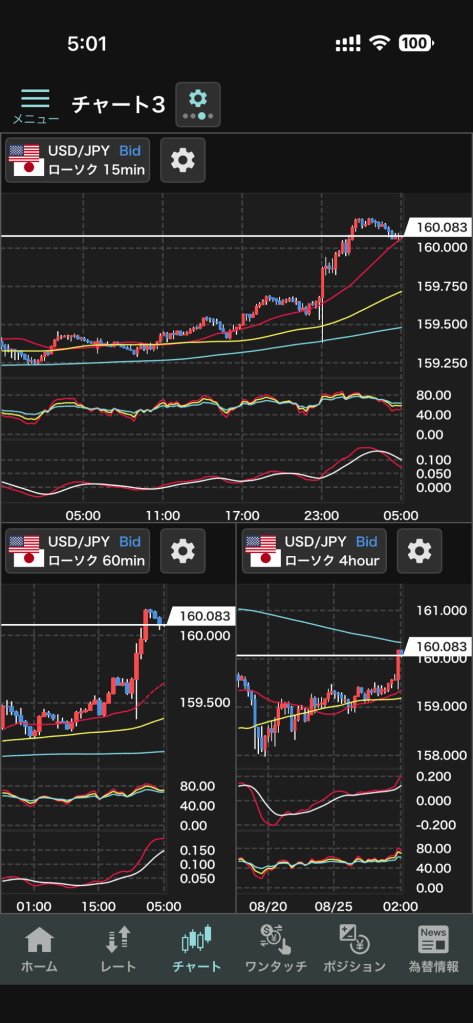
USD/JPY surged sharply from the 159-yen range and eventually moved above 160 yen.
I was on the wrong side of the move.
I had a short position.
And I took a big loss.
But there was one thing I did right.
I cut my loss.
“It will come back” can be dangerous
When USD/JPY rises quickly, it is very tempting to think:
“It can’t keep going.”
“It’s already near 160.”
“Surely it will fall soon.”
But the market doesn’t care what I think.
Looking at the chart afterward, the strength of the move is obvious.
The 15-minute and one-hour charts showed a powerful rise, and even the four-hour chart was pushing higher.
If I had simply waited and hoped for the price to return, my loss could have become much larger.
That is why, although losing money hurts, I’m glad I used a stop-loss.
A stop-loss feels terrible when you actually take it
An unrealized loss still gives you hope.
Maybe the market will turn around.
Maybe you can get your money back.
But the moment you close the position, the loss becomes real.
That makes pressing the button difficult.
Recently, however, I have started thinking about stop-losses differently.
A stop-loss is not simply a button that confirms a loss. It is a button that prevents the loss from becoming even bigger.
I lost money this time.
There is no point pretending otherwise.
But without the stop-loss, I could have lost considerably more.
So instead of saying:
“I lost money because I stopped out,”
I can also say:
“My stop-loss prevented a bad trade from becoming a disaster.”
Major events are different
This was another important lesson.
Events such as Jackson Hole, central-bank announcements and suspected currency interventions can produce movements far beyond what we normally experience.
A price level that looks like an obvious turning point can simply be blown through.
I have already learned this lesson the expensive way before.
And yet, I did it again.
That is something I need to remember.
Sometimes the best trade around a major event is no trade at all.
Surviving matters more than being right
This trade was a failure.
But cutting the loss was not.
To continue trading FX for years, perhaps the most important thing is not predicting every move correctly.
It is avoiding the kind of loss that knocks you out of the market completely.
Looking at a chart afterward makes trading seem easy.
“I should have bought there.”
“I should have sold here.”
Real trading, with real money at risk, is completely different.
So my lesson from this trade is simple:
Don’t force a trade during a major market event.
And when the market proves you wrong:
Cut the loss.
Taking a loss hurts.
But looking at this chart afterward, I know one thing.
I’m glad I got out when I did.
Another expensive lesson from the FX market.
 Real Japan Life
コメントを残す